Is Hobart already a 15-minute city?

Firstly, what is a "liveable" or a "15-minute city"?
A liveable city is one where daily life is easy, healthy and connected. People have the option to reach work, shops, schools, parks and social spaces locally, without long or stressful journeys, and streets feel safe and comfortable for walking, cycling and public transport. The idea of a 15-minute city helps put numbers around this: it asks whether most people can meet their everyday needs within a short, local trip. In this way, the 15-minute city is best understood as a practical way of measuring liveability, rather than a new planning model or set of rules.
A liveable (15-minute) city typically includes:
- Local access to shops, services, schools and green space
- Safe, comfortable streets for walking and cycling
- Frequent and reliable public transport
- Mixed-use neighbourhoods with housing near daily needs
- Public spaces that support health, social life and inclusion
- Efficient and sensible access for motor vehicles, including:
- A street network where different streets serve different roles — some prioritising motor vehicles or through-traffic, others prioritising people, local access and place
- Commercial vehicle access to pedestrian areas in quiet times (as already occurs in Salamanca Square)
- Off-street parking and "Park and Rides"
- Prioritised access for people with mobility impairments
Hobart is a "16-minute" city
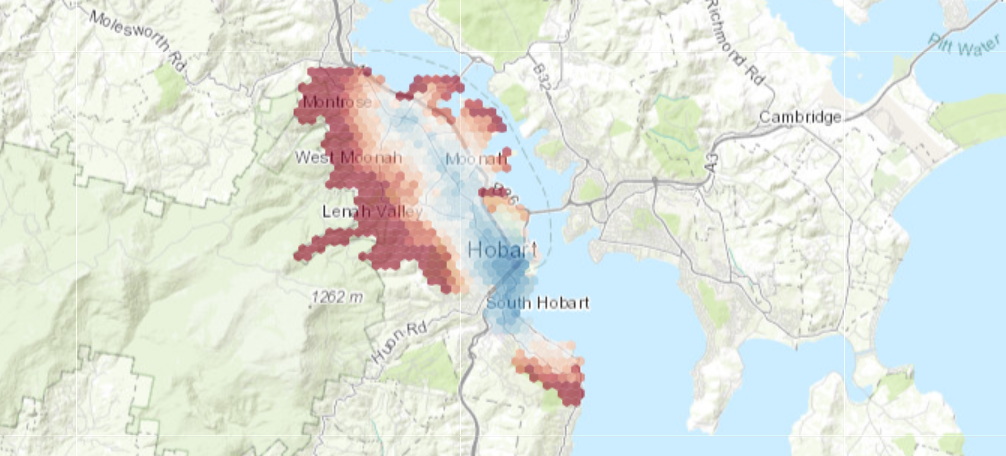
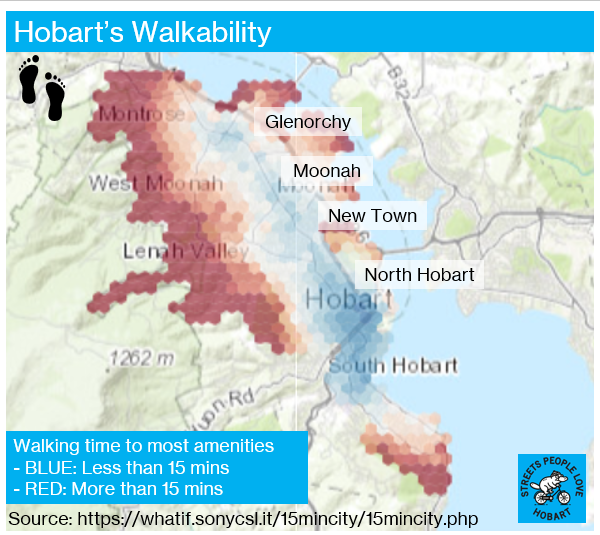
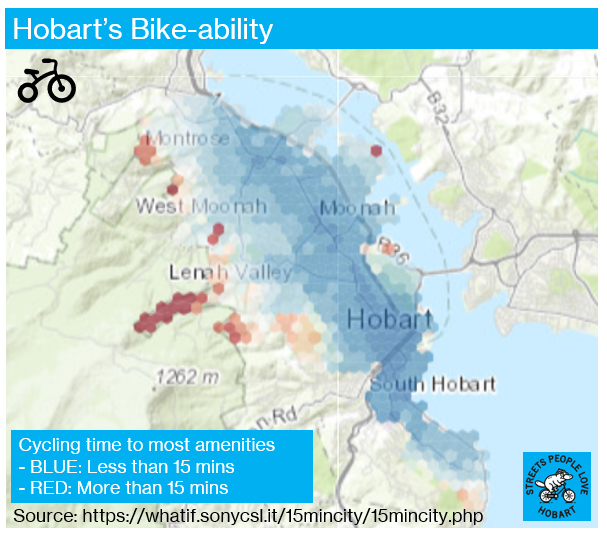
A global study by Sony Computer Science Laboratories assessed cities worldwide based on how close residents live to everyday amenities. Using this method, Hobart was identified as a “16-minute city”, meaning the average resident can reach daily needs within 16 minutes by walking, cycling or public transport.
The study assessed proximity to outdoor activities, learning, supplies, eating, transport, cultural activities, physical exercise, services and healthcare.
A link to the database is available here.
The results show that Hobart is structured around multiple suburban centres, forming a north–south corridor from Sandy Bay through the inner suburbs to Glenorchy. This pattern is explored further below.
How does Hobart compare to other cities?
In Sony CSL's study, Hobart ranks as the closest to a 15-minute city in Australia (noting that the eastern shore and southern suburbs such as Kingston were not included in the dataset). Lower numbers indicate shorter average travel times to daily needs.
- Hobart – 16 minutes
- Melbourne –17 minutes
- Canberra – 17 minutes
- Sydney – 19 minutes
- Adelaide – 19 minutes
- Darwin – 22 minutes
- Perth – 24 minutes
- Brisbane – 25 minutes
Why Hobart performs well
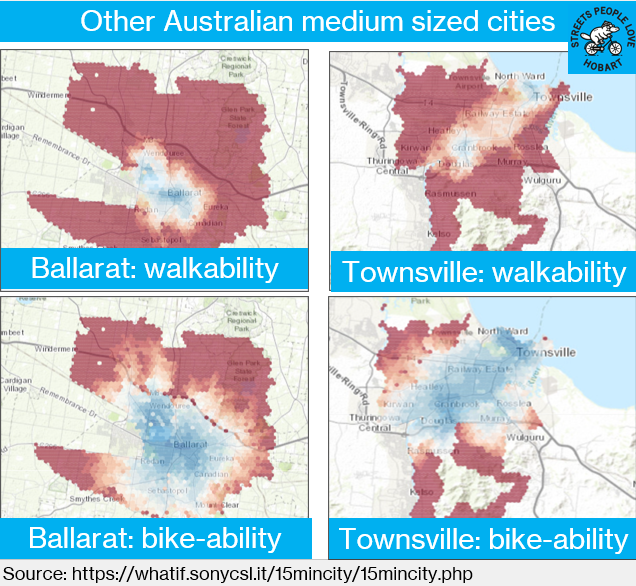
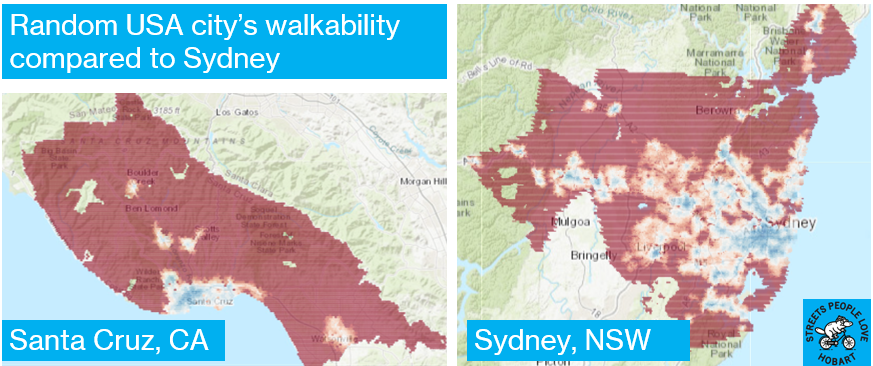
Cities with shops, schools, healthcare and parks repeated across suburbs allow more people to meet daily needs locally, without long trips. Hobart’s string of suburban centres along its north–south corridor supports this pattern.
By contrast, cities that concentrate services in a single urban core tend to sprawl outward. This increases distances, reinforces car dependence and reduces everyday walkability for most households. This effect is visible in regional Australian cities like Ballarat and Townsville, and is even more pronounced in many US cities, where extreme urban sprawl is common.
Are 15-minute cities about more than proximity?
Yes. While the Sony CSL study shows Hobart residents live relatively close to amenities, proximity alone does not guarantee liveability. Access also needs to be safe, comfortable and appealing.
Much of Hobart’s street network has historically prioritised cars. As a result:
- Footpaths are often narrow or inconsistent
- Streets can be difficult to cross
- Safe, connected cycling routes are rare
- Kerbs and surfaces make it harder to push prams or use mobility aids
- Streets often lack trees, shade and places to rest
- Public transport is widely perceived as infrequent or unreliable
Without addressing these factors, short distances don’t always translate into practical or attractive daily trips.
What next?
Hobart already has the urban structure of a 15-minute city. The opportunity now is to make its streets match that potential.
Streets People Love Hobart will continue to advocate for people-friendly streets that make walking, cycling and public transport safe, comfortable and appealing for everyone.